Samsung Leads Global Smartphone Market in Q1 2026: Omdia

SammyGuru is reader-supported. We have affiliate and sponsored partnerships, so we may earn a commission when you buy through links on our site — at no extra cost to you. Learn more.
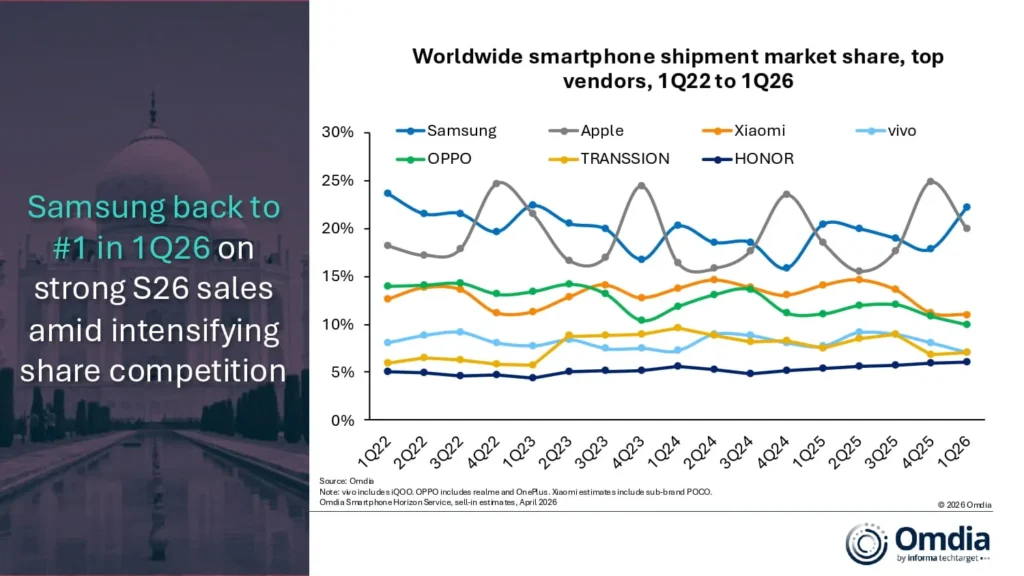
Samsung lost the crown in Q4 2025 to its arch-rival Apple in the global smartphone market. The company has now reclaimed the top spot thanks to strong shipment growth in Q1 2026. The newly launched Galaxy S26 series played a prominent role in pushing this recovery and boosting overall performance.
Samsung sees growth as Galaxy S26 pushes shipments higher
According to data from Omdia, Samsung led the global smartphone market in Q1 2026 with shipments of 65.4 million units. This is an 8% year-on-year increase (shipped 60.5 million units in Q1 2025). The company’s market share reached 22%, up from 20% in the same period last year.
Interestingly, these figures differ from Counterpoint Research’s preliminary data. The firm estimated a 6% year-on-year decline in Samsung’s Q1 2026 shipments, citing weaker mass-market demand and a delayed S26 series launch. Thankfully, strong demand for the Galaxy S26 series around the world appears to have helped offset the impact of the delay.
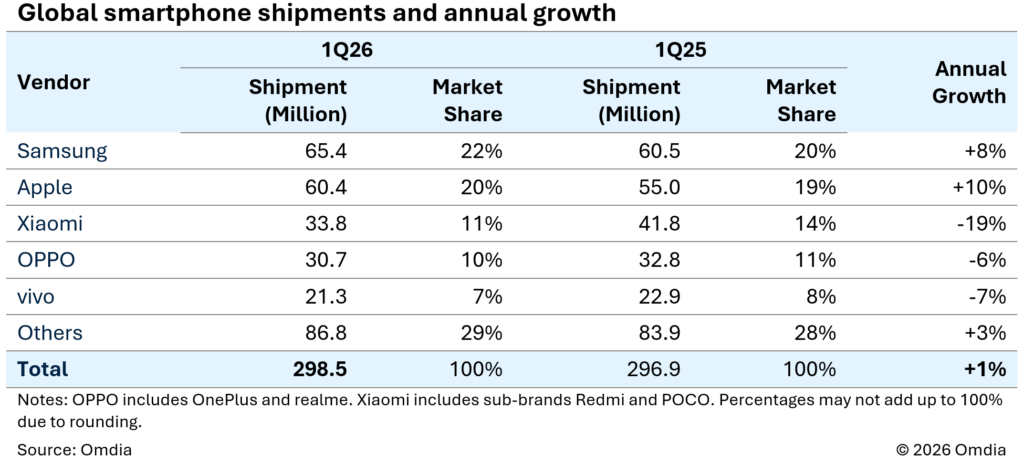
“The result reflects resilience across both ends of its portfolio: entry-level A-series volume anchored emerging market shipments, while strong demand for the Galaxy S26 series drove premium growth,” said Omdia. This also appears to support overall global smartphone shipments, which grew 1% year-on-year in Q1 2026. Other factors include most OEMs, including Samsung sped up shipments ahead of possible increases in memory and component costs.
In Q2 2026, Samsung continues to see buyer traction for its Galaxy S26 series, reportedly leading to an increase in previously planned production volumes. Meanwhile, Samsung recently expanded its Galaxy A lineup with the Galaxy A57 and A37. All things considered, we can expect further shipment growth momentum for this quarter.
Speaking of Apple, the company secured second place with 60.4 million units shipped (up 10% year-on-year). Xiaomi came in third with 33.8 million units shipped (down 19% year-on-year). OPPO (including realme and OnePlus) ranked fourth with 30.7 million units, while vivo came fifth with 21.3 million units.

Written by
Binay KonwarBinay Konwar started his blogging journey in 2014 and has since written plenty of tech articles. At present, he is working as a News Writer at SammyGuru, covering everything about Samsung. He holds a Master's degree in Mathematics, but his real passion lies in tech and writing. In his free time, he enjoys playing chess and watching movies.

Follow us on Google Discover & set us as a preferred source in Google News
Share this Post
___________________________


New Blog Posts
___________________________
Qualcomm’s Snapdragon Price Hike May Add to Galaxy S27 Costs
Double-digit price hike for Snapdragon chips
Do Galaxy Z Fold 8, Fold 8 Ultra and Flip 8 Support Emergency Satellite SOS?
It’s good to have this feature in any case tho….
Galaxy Z Fold 8 Ultra is Here — Should You Upgrade from Fold 6 or Fold 7?
Fold 8 Ultra focuses on actual usage rather than specs