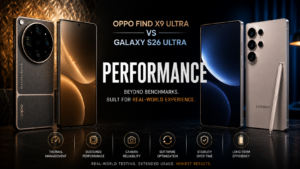
OPPO Find X9 Ultra vs Galaxy S26 Ultra: Action Video Mode Is a Lesson in Software Maturity
SammyGuru is reader-supported. We have affiliate and sponsored partnerships, so we may earn a commission when you buy through links on our site — at no extra cost to you. Learn more.
In this article
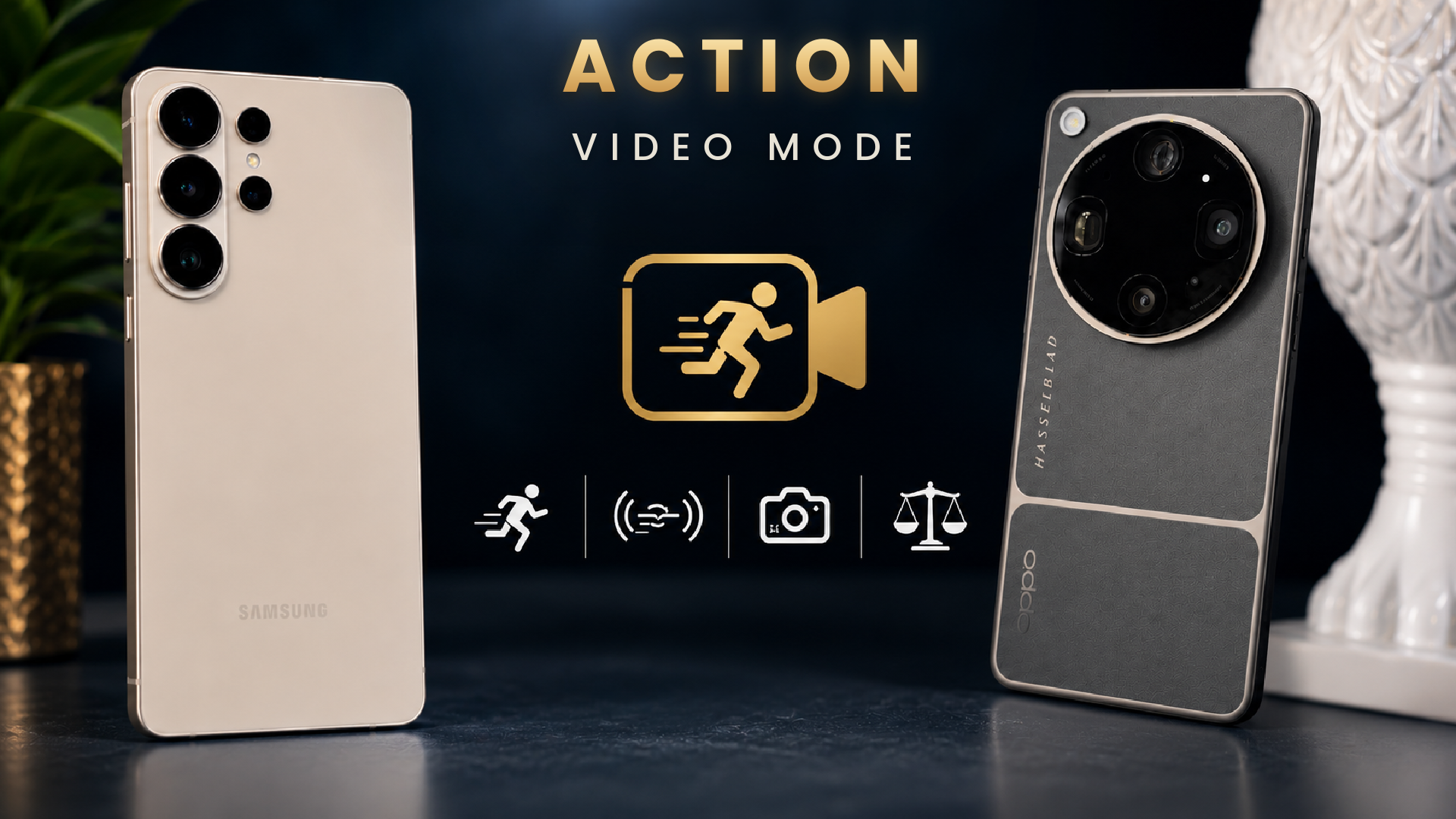
In the latest episode of our OPPO Find X9 Ultra vs Galaxy S26 Ultra camera comparison series, we look into Action Video Mode. This category highlights how modern smartphone cameras are increasingly defined by software rather than hardware alone. Nearly every flagship can reduce shake, but the real difference lies in how each system manages motion, image quality, and consistency under real-world conditions.
Before diving into the comparison, a small confession:
Apple may have chosen the best name for this type of feature. “Action Mode” is simple, easy to understand, and perfectly describes its purpose. Samsung calls its implementations Super Steady Mode and Horizontal Lock, while OPPO simply uses Ultra Steady Mode. Throughout this comparison, however, I will refer to all of them collectively as Action Mode because it best reflects what these systems are actually designed to do.
Samsung Takes Two Different Paths
Samsung approaches action recording with two separate systems: Super Steady Mode and Horizontal Lock. Although they appear similar at first glance, they are designed with different priorities. Super Steady Mode relies on aggressive electronic stabilization to minimize camera shake, while Horizontal Lock focuses on maintaining a level horizon and smoother camera movement with less visible correction.
Online demonstrations often showcase Horizontal Lock under extreme running, spinning, or rapid rotation, creating impressive social media clips that very few users will realistically attempt themselves. But daily ownership tells a different story.
Horizontal Lock Quietly Becomes Samsung’s Best Action Mode
Across extended testing, Horizontal Lock consistently produced smoother footage with fewer visible correction jumps than Super Steady Mode during normal walking and handheld movement. The resulting video feels more natural while preserving better image quality and reducing the artificial look that can appear when stabilization becomes overly aggressive.
For travel, family recording, casual content creation, and everyday shooting, Horizontal Lock often becomes the mode that users can simply trust.
Samsung Still Has One Important Limitation
Despite its impressive performance, Samsung restricts its Action Mode implementation to the Ultra-Wide camera and the Main camera up to 2x zoom with Maximum QHD 60fps. Beyond that point, the feature is simply unavailable, leaving no Action Mode support for Samsung’s longer telephoto focal lengths.
This creates a major opportunity for OPPO, whose implementation appears considerably more ambitious.
OPPO Pushes Action Mode Beyond Samsung’s Limits
OPPO extends Ultra Steady Mode across multiple focal lengths, including longer telephoto ranges up to 4k 60fps, which Samsung currently does not support. Even more impressive, the feature continues operating under lighting conditions where Samsung frequently warns that additional illumination is required.
From a capability perspective, this is one of OPPO’s most forward-thinking camera features. The hardware clearly has the potential to lead this category. However, during extensive testing, one recurring issue repeatedly appeared around OPPO’s 3x telephoto camera.
The disappointing part is not the image quality. The 3x camera itself produces excellent detail, color, and rendering. What undermines the experience is the instability that appears during motion. The behavior appears more consistent with software processing than with a hardware limitation, as the correction occasionally introduces abrupt jumps that interrupt otherwise smooth footage.
The result is a video that feels less stable than the underlying hardware suggests it should be. Visible shaking and sudden micro-corrections can appear while moving, and the same behavior carries into 6x recording, significantly reducing confidence in one of OPPO’s biggest hardware advantages. Interestingly, the behavior is not limited to Ultra Steady Mode alone, suggesting that the issue may extend beyond the stabilization mode itself.
Hardware Raises Even More Questions
The situation becomes even more surprising considering that OPPO promotes its 3x telephoto camera with first-class optical stabilization. On paper, this should provide an excellent foundation for stabilized video capture, especially at longer focal lengths where stabilization becomes increasingly important. Yet real-world testing tells a more complicated story.
The hardware appears capable, but the overall experience suggests that software coordination between stabilization, motion prediction, and image processing still requires further refinement. The potential is clearly there, but the execution has not yet reached the same level.
Capability Means Little Without Consistency
This category perfectly illustrates the growing role of computational photography in modern smartphones. Hardware provides the foundation, but software ultimately determines whether that potential reaches the user. A more capable system on paper can quickly lose its advantage if stabilization algorithms fail to deliver consistent real-world behavior.
Samsung demonstrates this philosophy well. Its implementation supports fewer focal lengths but executes them with remarkable consistency. OPPO reaches significantly further, yet the current software behavior prevents its most ambitious feature from reaching the same level of reliability.
Execution remains just as important as capability. At first glance, OPPO appears ready to secure another clear victory thanks to broader Ultra Steady support, superior telephoto image quality, and the ability to operate in lower-light environments where Samsung becomes more restrictive. But the instability surrounding the 3x camera prevents the company from fully capitalizing on its hardware advantage.
Samsung’s Horizontal Lock system, on the other hand, emerges as the more dependable solution for everyday action recording. It earns one point through consistency and refinement, although OPPO deserves recognition for pushing stabilization further than its competitors. Multi-lens support, telephoto Action Mode capability, and low-light functionality represent genuine innovation, earning OPPO a point despite the current software shortcomings.
Current Comparison Standing
This comparison series evaluates long-term flagship ownership rather than isolated benchmark victories or specification advantages alone. Each category focuses on what genuinely shapes the daily ownership experience, including camera behavior, endurance consistency, charging flexibility, usability, and software refinement.
After evaluating Telemacro capability, Zoom Performance, Design Choices, Camera Usability, Pre-order Experience, Unboxing, Battery Architecture, Standby Efficiency, Charging Experience, Auto Mode Photography, RAW Photography, Special Modes, Slow Motion, and now Action Video Mode, both brands add another point to their scorecards, keeping the overall balance of the comparison unchanged.
OPPO now holds 15 points, while Samsung reaches 13, maintaining OPPO’s two-point advantage as the comparison enters its next phase.
At this stage, however, the Action Video category feels remarkably close. Samsung wins through refinement and consistency, while OPPO wins through broader capability and ambition. The current 3x camera behavior prevents OPPO from fully capitalizing on its hardware advantages, leaving the overall experience more balanced than the specifications suggest.
If OPPO resolves the 3x stabilization issue through a future software update, the advantage could shift decisively in its favor. The hardware already demonstrates enormous potential—now the software needs to catch up. Time will tell.
Portrait Photography, Auto and Pro Video Performance, Display Quality, UI and ecosystem advantages, Audio Performance, and Long-Term Software Experience are still to come, leaving plenty of opportunities for momentum to change. This comparison is becoming less about hardware superiority and more about software maturity.
In 2026, software refinement may matter more than hardware capability itself.


Follow us on Google Discover & set us as a preferred source in Google News
Share this Post
___________________________


New Blog Posts
___________________________

New Leak Says Samsung’s Clip-on Earbuds Won’t be Called Galaxy Able
The new pair are vastly different from Samsung’s current Galaxy Buds lineup

Samsung’s July 2026 Security Patch Fixes 57 Vulnerabilities
The company is expected to push the update in the coming weeks

Samsung Estimates 19x Jump in Q2 2026 Operating Profit
This is likely due to robust demand for AI memory chips