Samsung to Introduce Powerful On-Device AI as Early as Exynos 2800

SammyGuru is reader-supported. We have affiliate and sponsored partnerships, so we may earn a commission when you buy through links on our site — at no extra cost to you. Learn more.
Samsung is developing a new technology for its future Exynos chips. It will enable higher performance on-device AI in smartphones and tablets. The Galaxy S27’s Exynos 2700 is unlikely to feature this solution, but its successor could. Or at the latest, Samsung could debut it with the Exynos 2900.
Next Generation HBM Packaging
High-Bandwidth Memory (HBM) already exists in servers, providing them with better AI performance. However, mobile devices such as smartphones and tablets cannot utilize this technology due to constraints in size, power consumption, and thermal performance. Samsung is now developing a middleground, of sorts.
As reported by Jukan on X, this new technology aims to advance the current Vertical Cu-post Stack (VCS) by combining extremely high-aspect-ratio copper pillars with Fan-Out Wafer Level Packaging (FOWLP). The new “Multi Stacked FOWLP” could realize high capacity and bandwidth in mobile devices.
Samsung created VCS to overcome the limitations of LPDDR, including poor thermal and power efficiency as well as signal loss. VCS stacks DRAM dies in a staircase configuration and fills the gaps with copper pillars.
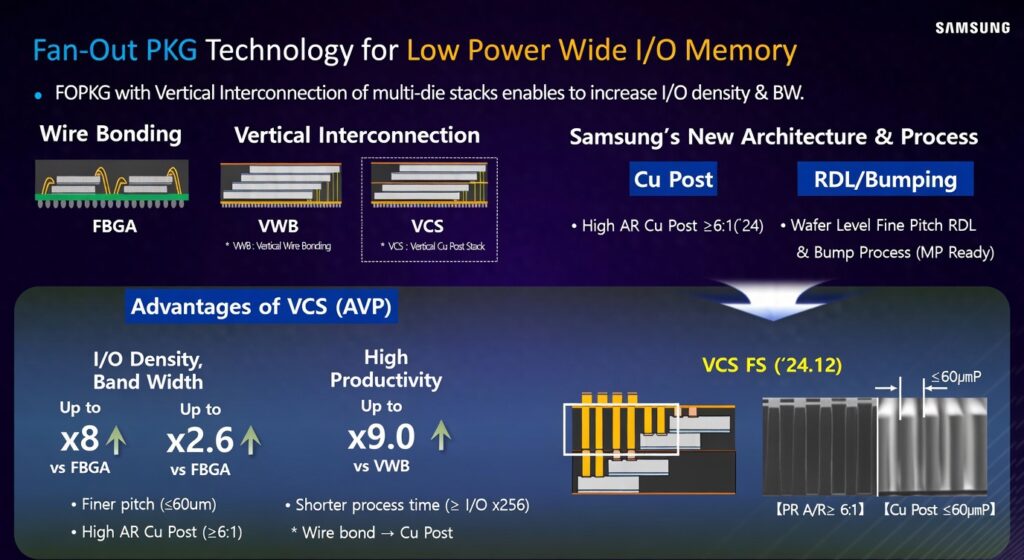
The next generation is taking advantage of high-aspect-ratio copper pillars, going from the existing 3:1 to 5:1 ratio up to 15:1 to 20:1, widening the bandwidth. The caveat being, when a pillar diameter is shrunk below 10 micrometers, the risk of bending or breakage is increased by a significant margin. This is where FOWLP processing comes in.
FOWLP molds the chip and extends the wiring. It serves as a structural support for the copper pillars. When combined with VCS, it provides a gain of 15% to 30% in bandwidth, along with a 1.5x improvement in memory stacking.
Timeline Challenges
We’re living in the AI boom, so High-Bandwidth Memory demand remains high for servers, data centers, and AI accelerators. It’s currently a challenge for Samsung to allocate its resources toward mobile HBM development. It’s unlikely we’ll see it for another two to three years. It may debut with the Exynos 2800 at the earliest, or maybe the Exynos 2900 at the latest. Another instance of a technological breakthrough hindered by scarce resources.

Written by
Aladdien FadhelAladdien Fadhel provides Samsung reviews and in-depth analysis for SammyGuru. By tracking the development of One UI and exploring Samsung's product roadmap, he delivers insights designed to benefit both the manufacturer and the user. A dedicated tinkerer, Aladdien prefers fine-tuning his current hardware to maximize its potential rather than opting for an immediate upgrade.

Follow us on Google Discover & set us as a preferred source in Google News
Share this Post
___________________________


New Blog Posts
___________________________

Apple May Have Just Made Samsung’s Next Price Hike Much Easier
AI is making your next phone more expensive
Samsung Cancelling Galaxy S26 Edge was a Mistake
Galaxy S25 Edge failed because its creator lacked faith in its capability

OPPO Find X9 Ultra vs Galaxy S26 Ultra: Pro Video Performance
Pro Video doesn’t follow the same script as Auto Video