Samsung Cancelling Galaxy S26 Edge was a Mistake

SammyGuru is reader-supported. We have affiliate and sponsored partnerships, so we may earn a commission when you buy through links on our site — at no extra cost to you. Learn more.
The Galaxy S26 Edge’s cancellation was already set in place the moment Samsung unveiled the S25 Edge. Samsung’s own market overshadowed the device, and the company failed to communicate its purpose. It beat Apple to the punch and released the Galaxy S25 Edge before the iPhone Air, but the execution resulted in a complete failure.
Samsung lacked confidence in its own product, and as a result, the Galaxy S25 Series ended up with four flagships instead of three. Apple succeeded where Samsung failed. I’ve seen far more iPhone Airs in the wild than I ever did with the iPhone Mini or iPhone Plus. In the end, Samsung trying to cover its bases resulted in losing a fantastic addition to its lineup.
The Galaxy S25 Edge needed better Marketing
Ultimately, there is a single factor that sealed the Galaxy S25 Edge’s fate: the Galaxy S25+. It was an unnecessary addition to the lineup. When the average consumer looks at the Galaxy S25+, and then at the S25 Edge, they see one less camera and a smaller battery, yet it’s more expensive. They won’t care enough to read about what it has to offer. They don’t see thinness as innovation in this instance, but instead as a downgrade.
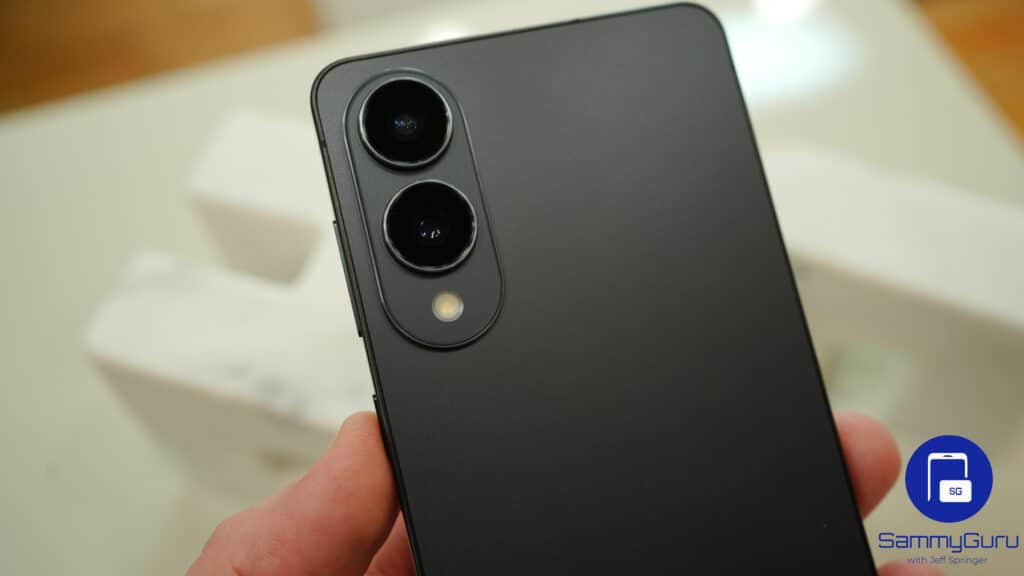
I won’t pretend that I could outdo a multi-billion-dollar company when it comes to marketing their product for sale, but I’ll try anyway.
While the Galaxy S25 and S25 Ultra were ready for pre-order after the event, the Galaxy S25 Edge would be available later “this year,” defining a new era for Samsung. Sure, we’d know about how it’s a device focused on thinness and a competitor for the iPhone Air, but it would be enough as a tease for what’s to come.
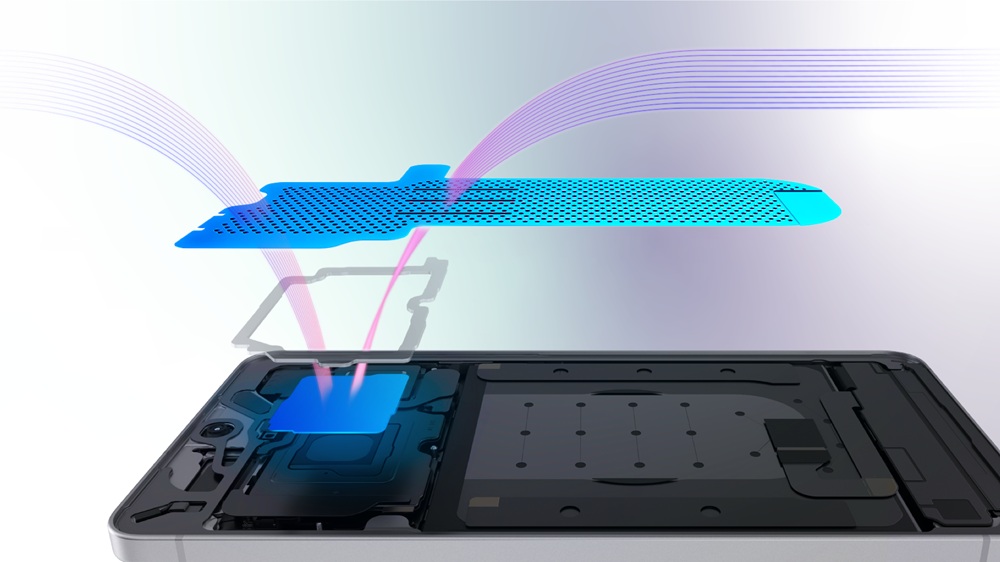
The Galaxy S25 Edge is an engineering marvel. It allows for the same 200MP camera found in the S25 Ultra to be fitted into a slimmer chassis. Samsung shaved layers off the sensor and still achieved 99% of the camera performance found in the S25 Ultra. You shouldn’t be worried about the thermals because even in such a slim chassis, Samsung managed to include a vapor chamber that is larger than what would be found in the Galaxy S24+.
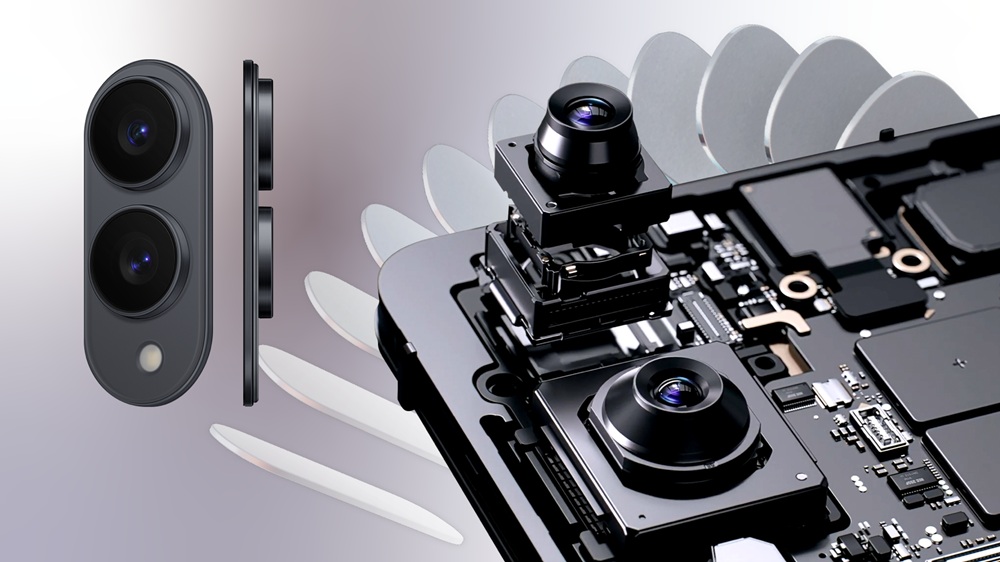
It may have one less camera than its previous device in the lineup, the Galaxy S24+, but it is far more capable. On top of capturing stunning photos at 1x, it can go all the way up to a 4x sensor crop. When it comes to actual photos you’ll want to keep and look back on, the 200MP sensor provides you with everything you’ll need to capture memories.
A thin device isn’t a gimmick. It was the next step forward. The Galaxy S25 Edge provided us a glimpse of what’s to come from Samsung. That was clearly the case, as the device set the foundation for the Galaxy Z Fold 7, a foldable that is as thin as a standard smartphone, packs amazing performance, and has an Ultra-capable 200MP sensor.

It was going to be a delayed release regardless, so Samsung might as well have slimmed down the lineup anyway. It still would’ve beaten Apple to the punch. The Galaxy S25 Edge provided more value over the iPhone Air with two cameras, bigger battery, and dual stereo speakers.
The Galaxy S26 Edge was on its way to be a great step up over the S25 Edge, particularly with the battery life. Alongside battery improvements, Samsung also planned to replace the 12MP ultrawide camera with a 50MP unit. At $1,099, it would’ve been a much stronger performer than the Galaxy S26+.
Galaxy S25 Edge was a Good Phone
Despite how some media questioned its existence, the Galaxy S25 Edge was a good phone. I was one of the first that thought it would be a disaster of a product because of the thermals and battery life. I purchased one to test out for a little bit, and I’m happy to admit I was wrong.
Not only was it performing better thermally than the Galaxy S24 Ultra I had at the time, but I was also able to get all-day battery life and even managed almost 8 hours of usage. If you want to read my full thoughts on the Galaxy S25 Edge, I have a review over on X.
The camera performance impressed me the most. For a single lens, it does the job wonderfully and even takes good 4x shots. Not saying it’ll outdo a dedicated telephoto lens, but it does well. I doubt most people are out here zooming in 10x for every single photo they take. 99% of their photography needs are satisfied with a single 200MP lens.

There is a single image I took where I actually paused and admired it. Samsung’s fantastic computational photography, using Expert RAW and combined with their new ProVisual Engine, churned out what I consider to be an amazing shot, with excellent color accuracy, detail, and proper background blur. I was a tad bit upset I ended up returning it at the end.
The Galaxy S25 Edge should have been the first step toward a compact Ultra device. It was nearly there. It had the performance, cooling, and the 200MP sensor was enough. Despite being so thin, it performed admirably. I was so excited for the Galaxy S26 Edge, with the addition of a 50MP Ultrawide and a battery capacity I had asked for. Only to learn of its cancellation. That was upsetting.
We already had all-day battery life. It performed similarly to my Google Pixel 9 Pro XL, and despite what enthusiasts say, it seems to be enough for most users. Had Samsung doubled down, improved the battery life and speakers, and replaced the Galaxy S26+, it would have been a knockout.
As an enthusiast, I want Samsung to listen less to criticism when it comes to the majority of use cases, but listen to critics when it comes to refining the overall experience. Sometimes, we don’t know what we have until it’s lost.
Samsung Made a Mistake: iPhone Air is the Proof
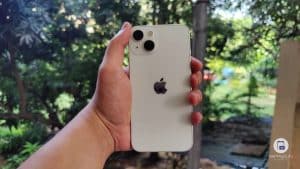
There’s been an increasing amount of iPhone Airs I’ve seen in the wild. Despite the single camera, worse battery life, and no stereo speakers, it has been a bigger success than the iPhone Mini and iPhone Plus. Samsung definitely dropped the ball.
As I was writing this up, I met someone using the iPhone Air and asked them how come they chose it. It was a better deal on the carrier plan. They were going to go for the iPhone 17 Pro Max for the bigger display, but because it wasn’t that much bigger, they went with the iPhone Air instead. Despite the drawbacks, the only complaint they had was how light it was. Not the camera or battery life, but getting used to the weight of the device.
Earlier this year, Ookla, a Wi-Fi speed test website, provided some data comparing the iPhone 16 Plus and iPhone Air. The iPhone Air was twice as popular as the iPhone 16 Plus. This isn’t the best metric, but it puts it into perspective how undesirable a larger base model is.
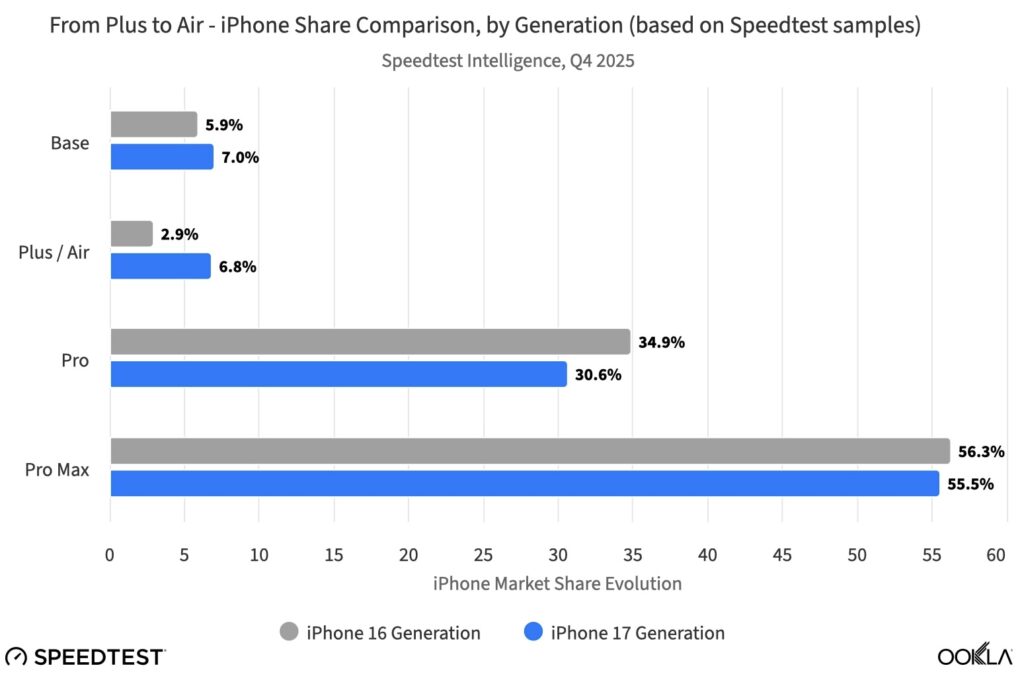
Based on a speed test, it seems the iPhone Air is twice as popular as the iPhone Plus. It is objectively worse than the iPhone 17, yet it is still pushing out numbers.
The Galaxy S25 Edge already matches, potentially outclassing, the iPhone Air 2 with dual camera sensors, stereo speakers, great haptics, and a bigger battery. Samsung should just replace the Plus line with the Edge. Don’t go any thinner. Keep the same thickness as the Galaxy S25 Edge, improve the battery capacity, give us a better front camera sensor, and add a 50MP ultrawide.
Where Apple did right is with marketing and lineup division. They didn’t have redundancy in their lineup. They have the base iPhone 17, the iPhone Air, the iPhone 17 Pro, and the iPhone 17 Pro Max. Each product has a purpose. Samsung throwing everything at the wall failed the Galaxy S25 Edge. After all, no one wants to spend an extra $200 for the same phone that just has a bigger display. Each product in a lineup requires purpose and intent.
The Branding of Edge Requires Greater Meaning
The Edge brand should mean Bleeding Edge. It would provide us a glimpse of what’s to come with future Samsung products, and it already has. The Galaxy S25 Edge set the foundation for the Galaxy Z Fold 7 with its 200MP sensor and slimmer chassis.
It would have been the perfect specimen for Exynos. The Galaxy S25 Edge already performed so well with the Snapdragon 8 Elite. The Exynos 2600’s improvements in the fabrication process and Heat Pass Block make it ideal for a thinner device.
Early rumors stated that the Galaxy S26 Edge would have packed a larger battery in a slimmer chassis, showcasing how mature Samsung’s engineering team is. They wouldn’t need to resort to an immediate jump to new technology. The Galaxy S26 Edge’s projected sales were evaluated based on poor execution.
The Galaxy S25 Edge didn’t fail because it was a bad product. It failed because its creator lacked faith in its capability.

Written by
Aladdien FadhelAladdien Fadhel provides Samsung reviews and in-depth analysis for SammyGuru. By tracking the development of One UI and exploring Samsung's product roadmap, he delivers insights designed to benefit both the manufacturer and the user. A dedicated tinkerer, Aladdien prefers fine-tuning his current hardware to maximize its potential rather than opting for an immediate upgrade.

Follow us on Google Discover & set us as a preferred source in Google News
Share this Post
___________________________


New Blog Posts
___________________________
Samsung’s HBM4E Reliability Yield Surpasses 70%
This suggests the chip could soon enter the stable production stage

Apple May Have Just Made Samsung’s Next Price Hike Much Easier
AI is making your next phone more expensive
OPPO Find X9 Ultra vs Galaxy S26 Ultra: Pro Video Performance
Pro Video doesn’t follow the same script as Auto Video