Samsung Lags Rivals in Telemacro and Long-range Zoom — What That Means for Galaxy S27 Ultra
For years, Samsung dominated the conversation around smartphone zoom cameras. Its Ultra models became the benchmark for long-range zoom, especially during the true 10x optical era, where Samsung managed to combine strong hardware with aggressive computational photography to hold the zoom crown for multiple generations. That’s no longer true.
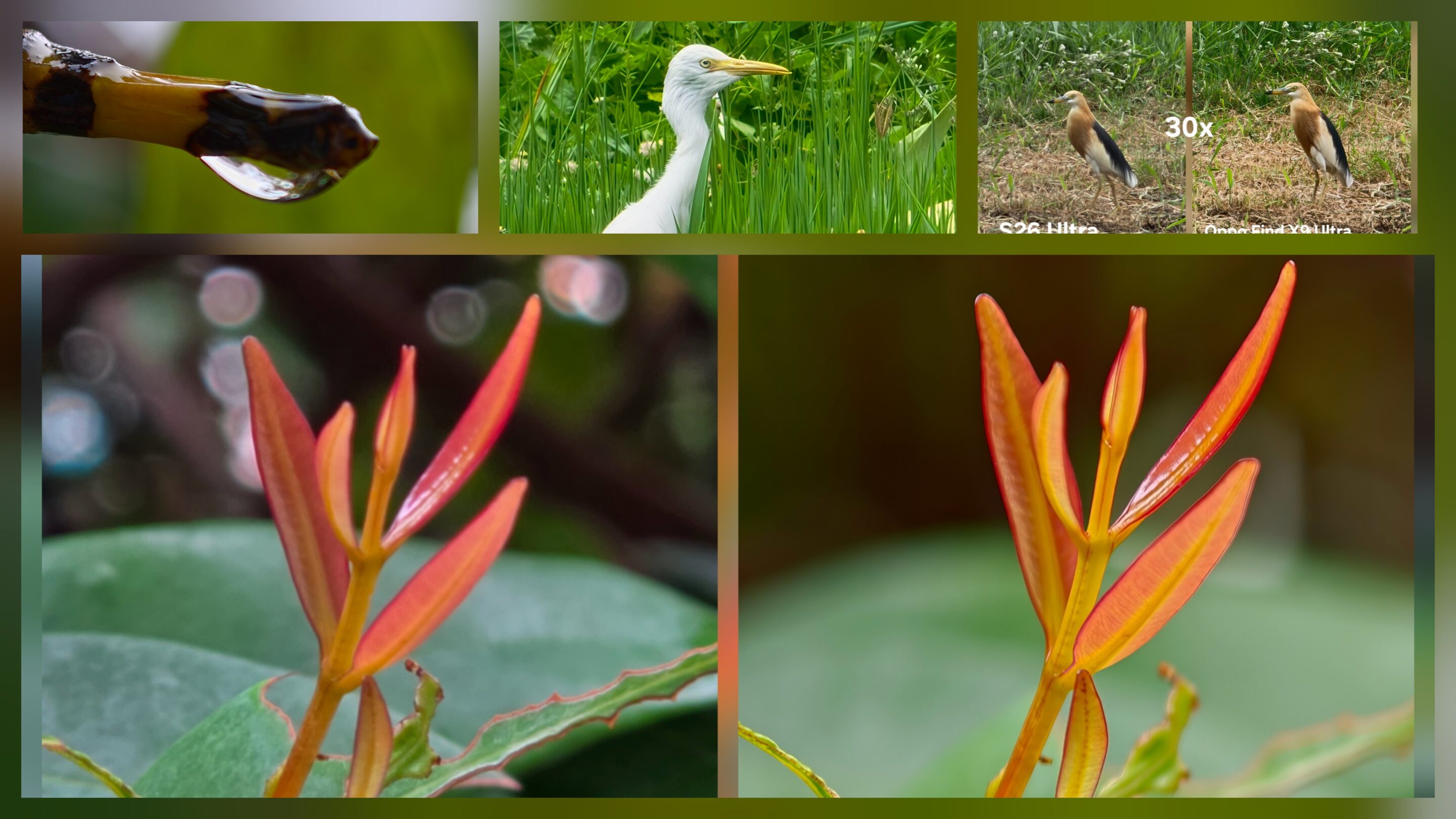
After using the OPPO Find X9 Ultra, I realized that the Galaxy S26 Ultra can’t match it in telemacro and long-range zoom. The battle isn’t just software versus software. It is optics versus optics — and in two important areas, Samsung is now fighting from behind.
The telemacro advantage Samsung currently cannot match
The OPPO Find X9 Ultra uses a massive 200MP 3x telephoto sensor with a 1/1.28-inch optical format, paired with a minimum focus distance close to 15cm. That combination completely changes how the camera behaves in real-world macro photography. Unlike traditional smartphone macro systems that rely heavily on ultra-wide lenses with exaggerated perspective and artificial depth separation, OPPO’s system behaves more like a real optical camera.

The large sensor creates natural background blur without forcing aggressive software simulation. The high megapixel count also gives the processing pipeline an enormous amount of data to work with. Even when moving beyond the native 3x range into 10x or 20x, the system still retains strong texture integrity because the crop originates from a very high-resolution optical source.
Traditional long telephoto lenses are often unusable for macro because their minimum focus distances become too long. OPPO’s dedicated 10x optical camera, for example, reaches roughly 100cm minimum focus distance, making it impractical for close-up work. Instead of forcing the 10x lens to do everything, OPPO optimized the 3x system to bridge both worlds — telemacro and mid-range zoom.
That design decision is why the camera feels so flexible in real usage.
Meanwhile, Samsung’s Galaxy S26 Ultra continues relying on a much smaller 3x sensor that simply carries far less optical data for close-range processing. In normal photography, that setup is usually enough to cover the 3x to roughly 4.9x range reasonably well. But telemacro pushes the hardware far beyond its comfort zone.


Yes, Samsung can still produce good macro shots sometimes. Processing can compensate in certain conditions. But consistency is the problem.
The smaller sensor cannot generate the same natural subject separation. It cannot hold the same micro-detail during close focusing. And once lighting conditions become more difficult, the gap becomes easier to see. OPPO’s larger sensor simply captures more optical information before software even begins processing the image.
Long-range zoom is becoming an optics battle again
Samsung deserves credit for what it achieved with software over the past few generations. The company managed to keep a 5x optical system surprisingly competitive against higher optical zoom competitors through advanced computational photography, multi-frame fusion, AI reconstruction, and sharpening pipelines.
But physics still matters. The OPPO Find X9 Ultra uses a true 10x optical system, while Samsung continues relying on a 5x optical camera. The moment users move beyond 10x magnification, the hardware gap becomes increasingly difficult to hide. At 20x, 30x, and above, OPPO retains stronger clarity and finer structural detail because the image starts from a stronger native optical foundation before digital cropping begins.
Software can reduce the gap. It cannot fully erase it.


Samsung’s processing still deserves recognition because the company keeps results usable far beyond what the optics alone should realistically deliver. But once users compare both systems side by side, especially in distant architecture, textures, or compressed landscapes, the advantage of native optical reach becomes obvious.
Even OPPO’s sometimes aggressive sharpening does not fully cancel the hardware lead. In fact, this is what makes the comparison fascinating. OPPO still needs tuning for more natural rendering in some scenarios, yet the optical foundation remains stronger. And optics always matter.
The Galaxy S27 Ultra now faces a real paradox
This entire situation creates a much bigger challenge for Samsung going into the Galaxy S27 Ultra. Current rumors suggest the company may remove the 3x lens entirely and rely more heavily on the 5x system. On paper, that strategy sounds logical. A larger new 5x sensor combined with fewer cameras and an upgraded main sensor could simplify the camera system while improving image consistency across different zoom ranges.
But there is one major problem. So far, no rumors mention any significant 5x sensor upgrade. And if Samsung keeps using the existing hardware philosophy, the entire strategy could backfire badly.
The 5x camera could still perform decent close-up photography on the Galaxy S25 Ultra with its 25cm minimum focus distance. But that situation is now changing with the Galaxy S26 Ultra. The combination of a larger aperture and Samsung’s ALoP lens design appears to push the minimum focus distance closer to the 40–50cm range. This reduces much of the flexible 5x telemacro behavior that previous Ultra models could still partially achieve.

And even before that shift, Samsung’s 5x system still did not approach what OPPO achieved with the Find X9 Ultra’s massive 200MP 3x telephoto system, which has an extremely short minimum focus distance of 15cm. Compared to 25cm on the S25 Ultra, the quality matches, but the distance does not.
If Samsung removes the 3x camera entirely without dramatically upgrading the 5x hardware, the company may eventually be forced to rely more heavily on traditional ultra-wide macro photography again.
Galaxy S26 Ultra users are already starting to experience the limitations of this approach in real-world scenarios. Ultra-wide macro still works for casual close-up shots. However, it struggles because of perspective distortion, weak subject isolation, inconsistent lighting behavior, and the need to move extremely close to the subject. Users increasingly prefer telemacro because it creates a more natural composition while allowing greater shooting distance and cleaner optical separation.
Samsung now has two possible directions. Either it introduces a significantly larger 5x sensor with much shorter focusing capability, effectively transforming it into a hybrid telemacro and long-range zoom camera, or keeps the dedicated 3x lens but upgrades it dramatically to compete with the new generation of large-sensor telephoto systems. Anything in between risks falling behind in both categories simultaneously.
The current ranking tells an interesting story
The ranking system in this comparison is designed around real user experience rather than isolated camera samples or marketing specifications. Each category awards points based on what users genuinely gain, and what they sacrifice, when using each device in everyday photography.</p>
Based on the categories already covered in previous comparisons — Camera usability; features and design; Pre-order experience and Unboxing — the score previously stood at: 3 for Samsung and 2.5 for OPPO. But after evaluating the telemacro capability and long-range zoom performance, both categories go to OPPO. Updated scores are 3 and 4.5, respectively.
This battle is no longer just about image processing styles or AI tuning. It is becoming a deeper conversation about camera architecture itself. About how much software can realistically compensate before optics reclaim control again. And right now, OPPO is forcing Samsung to answer a very uncomfortable question for the Galaxy S27 Ultra: Can software still carry the zoom race alone, or is it finally time for it to redesign the hardware philosophy entirely?
Stay tuned for the rest of the comparison. The race is becoming far more interesting now.

Follow us on Google Discover & set us as a preferred source in Google News
Share this Post
___________________________


New Blog Posts
___________________________
Apple’s Long Software Support Makes Samsung’s Past Feel Dated
Samsung was late on updates, but it’s no longer behind
Samsung and NVIDIA Talk Future Chips at Korea Meeting
Samsung aims to win more NVIDIA business with new chips
Samsung’s Best Devices Get Major Early Prime Day Discounts
Early Prime Day deals bring big savings on Samsung devices